


When it comes to McDonald’s equipment, most people might think of the fryers for French fries, the griddles for meat patties, and so on. Today, however, we are going to talk about a lesser-known piece of equipment – McDonald’s cold room.
Have you ever bitten into a McDonald’s Big Mac or a crispy Apple Pie and noticed the vibrant flavor of the ingredients? Cold Room isn’t just a storage unit; it is the guardian of quality. It is the reason why the lettuce is crisp, the meat is safe, and the sauces are perfectly chilled.

How Cold Rooms Help Deliver the Freshness You Taste
McDonald’s doesn’t use a one-size-fits-all approach to cold storage. Their facilities employ multiple temperature zones to accommodate different food types:
The Frozen Core (-18°C to -23°C)
French fries, beef patties, and frozen desserts require ultra-low temperatures. McDonald’s cold rooms maintain these items at precisely -18°C or lower, ensuring ice crystals don’t form and damage food texture. This precise control means your fries stay crispy and your patties retain their juiciness from delivery to service.
The Fresh & Chilled Zone (0°C to 5°C)
Fresh vegetables, dairy products, and prepared ingredients like lettuce, tomatoes, and cheese are stored in separate chilled zones. This temperature range slows bacterial growth while maintaining crispness and flavor—critical for items served raw or with minimal cooking.
Multi-Temperature Zones in Limited Space
Even smaller McDonald’s locations maximize efficiency by installing compartmentalized cold rooms with separate sections for different temperature requirements. This approach is particularly valuable for independent restaurants with limited square footage.
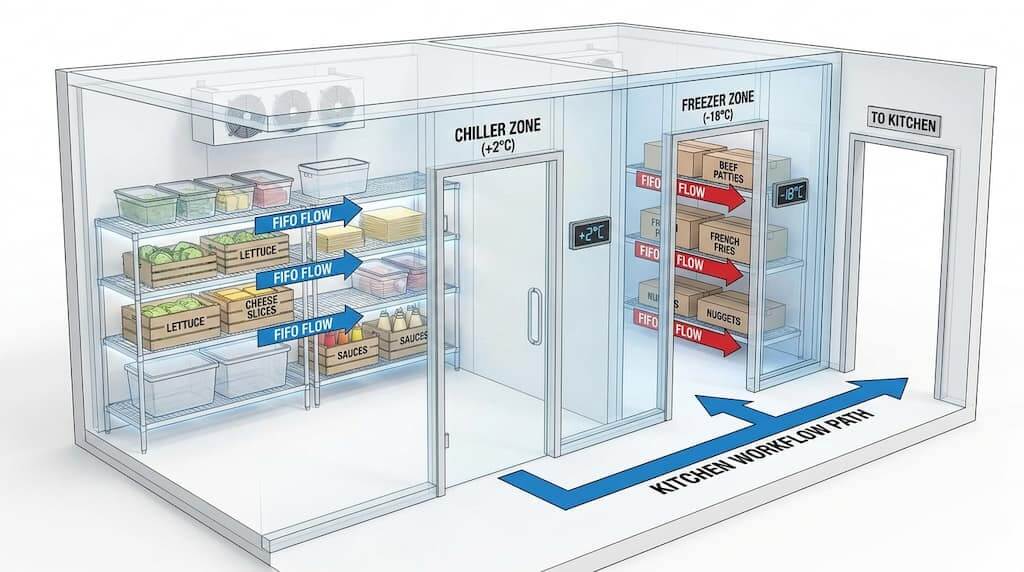
How McDonald’s Cold Room is Strategically Laid Out
Temperature Zoning & Physical Separation
Cold rooms use insulated partitions or heavy thermal curtains to separate frozen and chilled areas without building separate walk-ins. This saves floor space while preventing cold air loss, reducing compressor load, and eliminating cross-temperature contamination risks.
FIFO Workflow & Ergonomic Shelving
The “First-In, First-Out” principle dictates shelf placement. New stock enters from the rear or side access door, while older stock faces the service opening. Shelves are positioned at waist-to-eye level for high-turn items, reducing bending and reaching time. Heavy frozen goods stay low; lightweight produce goes higher. Gravity and human ergonomics work together.
Clear Aisles & Service-Facing Orientation
Wide, uncluttered aisles (minimum 36 inches) allow staff to move quickly during rushes. Labels face outward. The layout mirrors the cooking and assembly line outside, so a cook grabbing lettuce for a burger or patties for the grill doesn’t need to backtrack or cross paths with dish staff.
Why This Layout Works: The Real-World Functions
The design isn’t just about organization—it solves critical operational challenges that directly impact your daily run.
- Speed During Peak Hours
Every second counts. A well-laid-out cold room reduces retrieval time from 15-20 seconds to under 5. Cooks know exactly where to go, what to grab, and where to return empty containers. - Food Safety & Cross-Contamination Prevention
Raw ingredients are never stored above ready-to-eat or fully cooked items. Separate zones, dedicated containers, and drip-proof shelving prevent cross-contamination. - Inventory Control & Waste Reduction
Standardized container sizes and visual labeling make stock counts instant. The layout physically limits overstocking because shelf capacity is fixed, forcing disciplined ordering and par-level management.
The Bottom Line
McDonald’s success isn’t just about marketing or recipes—it’s built on operational excellence. By maintaining precise temperatures, reducing waste, ensuring safety, and managing costs, McDonald’s cold room systems provide competitive advantages that pay for themselves.
Whether you’re running a single restaurant or managing a growing food service operation, investing in quality cold room infrastructure isn’t an expense—it’s a strategic decision that impacts food quality, customer satisfaction, and your bottom line every single day.