

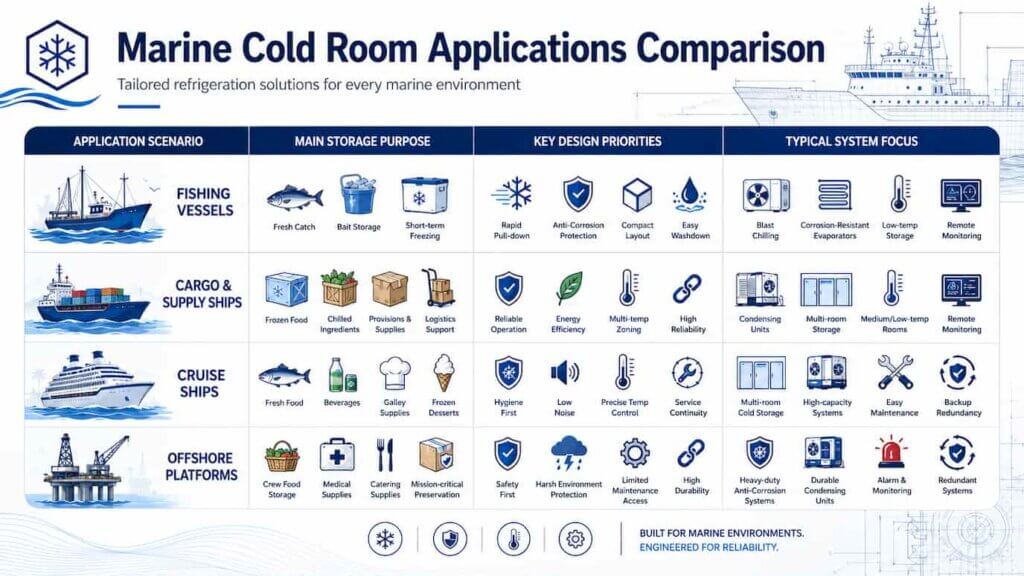
In marine environments, stored goods may include fresh food, frozen products, galley supplies, and other temperature-sensitive materials that must remain stable throughout the voyage. Unlike land-based systems, a marine cold room must operate under motion, humidity, salt exposure, and limited onboard space, which makes application-based design especially important. From fishing vessels and cargo ships to cruise liners and offshore platforms, different operating scenarios place very different demands on cold room layout, temperature control, hygiene, durability, and maintenance access.
Marine Cold Rooms for Fishing Vessels
On fishing vessels, a marine cold room is directly linked to catch quality, storage efficiency, and commercial value. Fish and seafood must often be chilled or frozen soon after handling to reduce spoilage and maintain product condition during extended time at sea. In this scenario, the design priority is usually fast temperature pull-down, reliable insulation, corrosion-resistant construction, and a layout that supports efficient loading and unloading. Because fishing operations can be intensive and space is often limited, the marine cold room also needs to balance storage capacity with easy cleaning, durable interior surfaces, and dependable performance under continuous use.
Cold Storage Solutions for Cargo and Supply Ships
On cargo ships and supply vessels, a marine cold room is designed primarily to support onboard living needs and routine logistics rather than fish preservation. It is commonly used to store meat, vegetables, dairy products, frozen food, and other provisions that must remain in stable condition during long voyages or offshore service cycles. In this application, the key requirements are dependable temperature control, rational internal partitioning, and efficient use of limited onboard space. A well-planned marine cold room should also make daily access easier for the crew while helping reduce temperature fluctuation, improve storage organization, and maintain reliable performance over extended operating periods.
Marine Cold Rooms for Cruise Ships and Catering
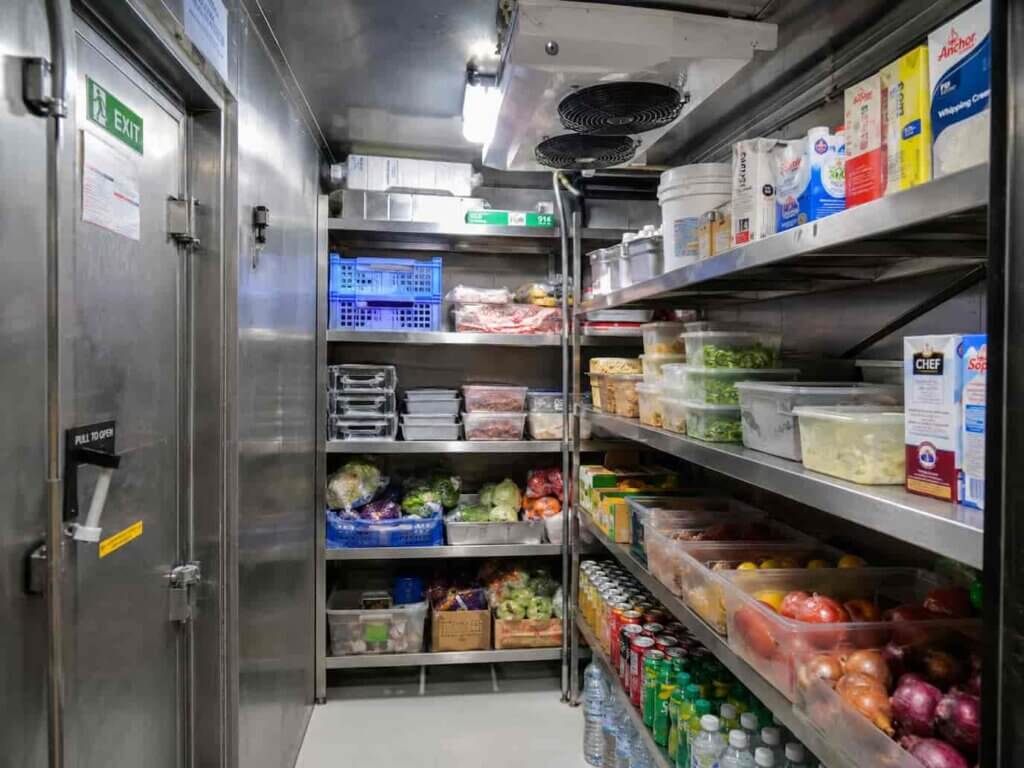
On cruise ships and catering-focused vessels, a marine cold room must support a much broader range of food storage requirements and a much higher standard of hygiene. These applications typically involve separate storage for fresh ingredients, frozen food, beverages, and prepared items. In addition to reliable cooling performance, the system should be designed for frequent access, easy cleaning, and smooth coordination with galley operations. For this reason, a marine cold room in cruise and catering settings is often expected to combine sanitary design, efficient workflow, and consistent temperature control in a limited onboard space.
Offshore Platform Cold Room Applications
On offshore platforms, a marine cold room is mainly used to store food and daily provisions for personnel working offshore for extended periods. Since resupply is not always frequent, the system needs to provide dependable cold storage that supports stable daily operations and efficient inventory management. In this scenario, storage capacity and internal organization are especially important, as the cold room must handle larger volumes of goods while keeping different product types properly arranged.
Compared with many vessel applications, offshore platforms place greater emphasis on long-term reliability and practical operation. A Marine cold room in this environment should be built to withstand humid, saline conditions while maintaining consistent temperature performance over time. It should also allow convenient access, easy cleaning, and efficient use of available space, helping offshore teams manage provisions more effectively throughout the service cycle.
Conclusion
Different marine applications create different storage demands, operating conditions, and design priorities, which is why system planning should always start with the actual use scenario. Whether the project involves a fishing vessel, a cargo ship, a cruise liner, or an offshore platform, the right Marine cold room design can improve storage efficiency, support daily operations, and deliver more reliable long-term performance.
For buyers and project teams, the key is to look beyond basic cooling capacity and focus on how the system will function in real marine conditions. When the design matches the application, a marine cold room becomes a more practical, durable, and valuable part of the overall operation.