


In today’s fresh produce supply chain, maintaining the quality of delicate fruits like blueberries, strawberries, raspberries, and blackberries is a constant challenge. These berries are highly perishable, sensitive to temperature fluctuations, and prone to rapid moisture loss and microbial spoilage. Without proper storage conditions, even a short delay in cooling can lead to significant product loss and reduced market value.
A well-designed Berry Cold Room plays a critical role in preserving freshness, extending shelf life, and ensuring consistent quality throughout storage and transportation. For commercial growers, exporters, and distributors, investing in the right berry cold storage solution is not just about preservation—it directly impacts profitability, supply chain efficiency, and customer satisfaction.
In this article, we’ll explore the key challenges in berry storage, the optimal environmental conditions for different berry types, and how a professional fruit cold room system can help you minimize waste and maximize returns.

Challenges in Berry Storage and Distribution
Due to their soft texture and high respiration rate, berries such as blueberries, strawberries, raspberries, and blackberries begin to deteriorate almost immediately after harvest.
One of the biggest challenges is temperature sensitivity. Even slight deviations from the optimal range can accelerate spoilage and shorten shelf life. In addition, humidity control is equally critical—insufficient humidity leads to dehydration and weight loss, while excessive moisture encourages fungal growth.
Another key issue lies in the complexity of the supply chain. Berries are often transported across long distances, especially in export scenarios, requiring consistent cold chain management from farm to final destination.
Moreover, improper handling practices—such as overloading storage space, poor air circulation, or delayed pre-cooling—can further compromise storage performance.
Ideal Temperature & Humidity for Each Berry Type
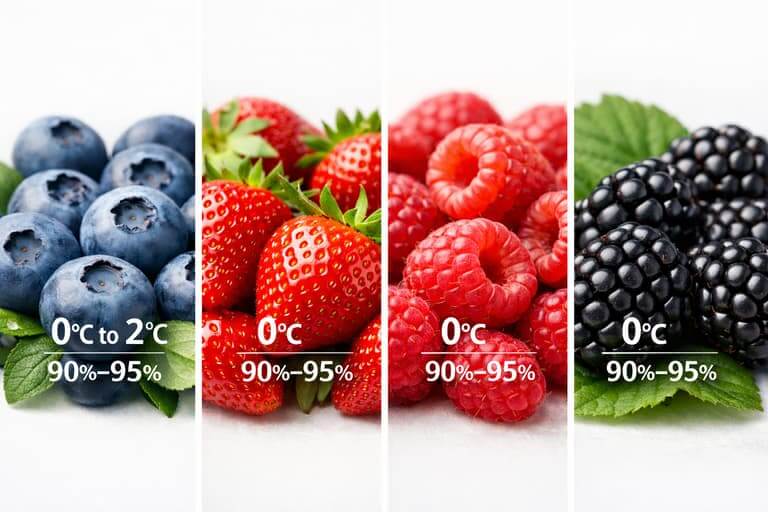
A properly configured Berry Cold Room should be able to maintain stable conditions based on the specific berry type being stored. Even when the recommended range appears similar, storage management should not be treated the same for every berry.
| Berry Type | Ideal Temperature | Ideal Relative Humidity | Storage Focus |
|---|---|---|---|
| Blueberries | 0°C to 2°C | 90% to 95% | Reduce respiration rate and minimize moisture loss |
| Strawberries | 0°C | 90% to 95% | Protect surface quality and reduce dehydration and decay risk |
| Raspberries | 0°C | 90% to 95% | Maintain texture and slow rapid deterioration |
| Blackberries | 0°C | 90% to 95% | Preserve firmness and reduce shrinkage during storage and transport |
Key Features of a Berry Cold Room System
A commercial berry cold room should do more than simply provide low temperatures. To protect delicate fruits such as blueberries, strawberries, raspberries, and blackberries, the system needs to support stable, precise, and efficient storage conditions.
- Precise temperature control
The cold room should maintain a stable temperature close to 0°C with minimal fluctuation. Consistent cooling is essential for slowing respiration, preserving texture, and extending shelf life. - Reliable humidity management
Proper humidity control helps reduce dehydration, shrinkage, and weight loss. At the same time, humidity levels must remain balanced to avoid excess moisture that may increase the risk of decay. - Uniform air circulation
Even airflow throughout the room helps prevent hot spots and uneven cooling. This is especially important in commercial storage, where inconsistent air distribution can lead to localized spoilage. - Rapid pre-cooling performance
Berries should be cooled as soon as possible after harvest. A system with strong pre-cooling capability can remove field heat quickly and help preserve freshness during subsequent storage and transport. - Smart monitoring and control
Modern fruit cold room systems often include sensors and automated controls for temperature, humidity, and operational status. This helps operators maintain stable conditions and reduce losses caused by manual errors or equipment issues. - Storage layout suited to delicate fruit
The internal layout should support efficient loading, unloading, and airflow around packaged berries. Proper space planning helps protect product quality while improving operational efficiency.
Case-Based Applications (Farms, Export, Wholesale)
A Berry Cold Room can support different parts of the berry business, from harvest to distribution. Whether you are handling blueberries, strawberries, raspberries, or blackberries, the role of the cold room may vary depending on where it is used in the supply chain.
- On farms and at harvesting sites
For growers, the biggest priority is to cool berries down as quickly as possible after harvest. A cold room helps remove field heat, protect fruit firmness, and buy valuable time before packing or shipping. This is especially important for soft berries that can lose quality very quickly. - For export operations
In export business, storage is not just about keeping berries cold—it is about keeping conditions stable at every step. A Berry Cold Room helps exporters hold products in a controlled environment before loading, which makes it easier to maintain quality during long-distance transport. - At wholesale and distribution centers
For wholesalers, the cold room is part of daily inventory management. It allows berries to be stored in an organized way, handled in larger volumes, and kept in saleable condition while waiting for delivery to different customers. - Closer to retail or local delivery
Smaller cold rooms can also be useful near the end of the supply chain. They help businesses manage short-term storage and daily dispatch, so berries can reach stores or end customers with better freshness.

In simple terms, the same fruit cold room system can serve different purposes depending on the business model. For farms, it supports fast post-harvest cooling. For exporters, it protects product quality during long-distance movement. For wholesalers, it helps manage volume and maintain consistency.
Common Storage Mistakes to Avoid
Why do berries still spoil even when they are stored in a cold room?
In many cases, the problem is not the Berry Cold Room itself, but unstable operating conditions. If the temperature fluctuates too much, humidity is not well controlled, or berries are placed into storage too late after harvest, quality can still decline very quickly.
Is colder always better for berry storage?
Not necessarily. Berries are usually stored as close to 0°C as possible, but the key is stability. If the room temperature keeps going up and down, the fruit can deteriorate faster than expected. Good control is more important than simply setting the system colder.
What happens if humidity is too low or too high?
If humidity is too low, berries lose moisture, which affects weight, appearance, and texture. If humidity is too high, the risk of condensation and fungal growth increases. A professional fruit cold room system should keep that balance as steady as possible.
Why is pre-cooling so important?
Because berries start losing quality right after harvest. Delayed cooling means higher respiration, faster softening, and shorter shelf life. The sooner field heat is removed, the better the fruit will hold up during storage and transport.