


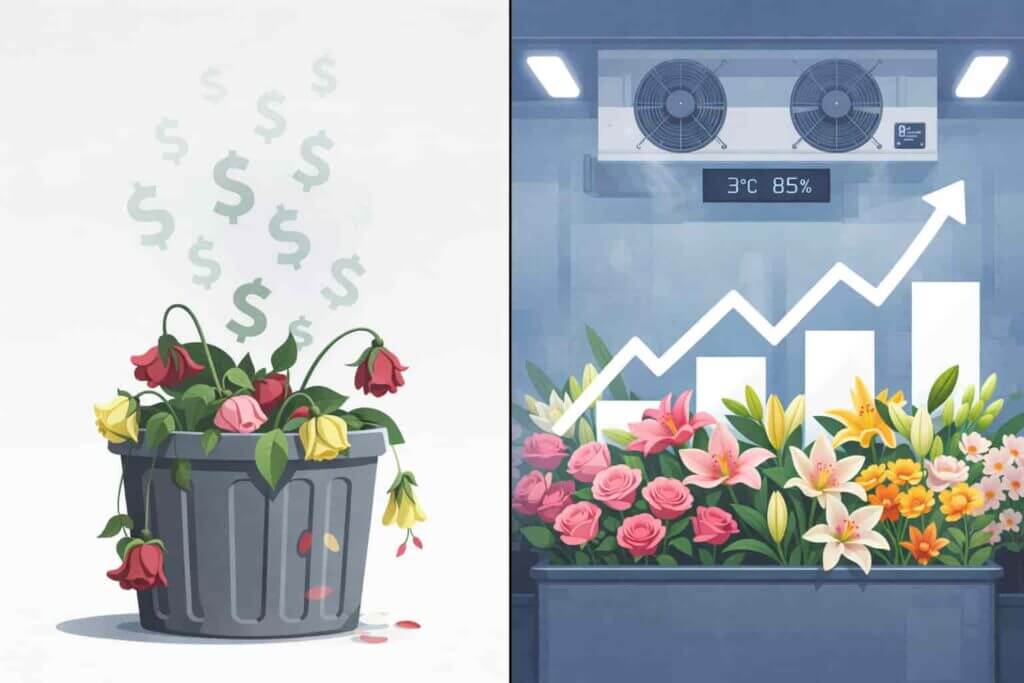
Whether it’s an anniversary, funeral, Valentine’s Day, wedding, birthday, promotion celebration, or any other occasion, flowers are indispensable. Symbolizing beauty, emotion, and celebration, flower preservation is therefore crucial to the floral industry.
For any professional florist, managing inventory is a constant balance between supply, demand, and the relentless clock of nature. Cold storage for fresh flowers is the secret weapon that halts that clock, extending vase life by days or even weeks.
The Principle of Cold Storage for Flowers
The science is straightforward: cold temperatures reduce the respiration rate of flowers, meaning they consume their stored sugars (their food source) much more slowly. Simultaneously, high humidity (typically 80-95%) prevents moisture loss through transpiration, keeping stems turgid and petals crisp. This combination puts the flowers in a state of “suspended animation,” preserving their just-picked freshness.
For florists, this brings real benefits. They can buy flowers in large quantities when wholesale prices are low. They can confidently accept big, last-minute orders. They can also handle busy seasons, like Valentine’s Day, without worrying about major losses.
Key Benefits of Investing in a Professional Flower Cold Room
The advantages of integrating a dedicated cold storage fresh flowers system into your shop extend far beyond simple preservation.
This is the most significant benefit. By extending shelf life, you slash the percentage of inventory you must throw away. What was once a 30% loss rate can easily fall below 10%, directly boosting your bottom line.
Flowers stored correctly emerge brighter, firmer, and longer-lasting for the end customer. Happy customers become repeat customers and powerful sources of word-of-mouth referrals.
A florist cooler allows for strategic purchasing. You can capitalize on wholesale price drops or seasonal availability without panic.
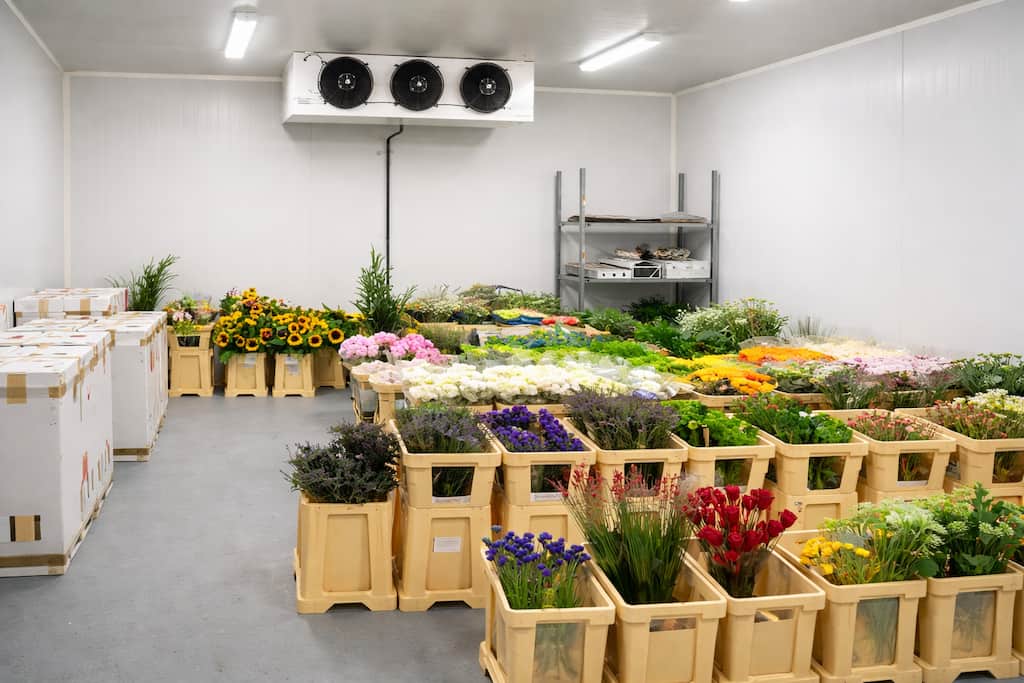
Florist Cold Storage Equipment
1. Insulation Panels (PU/PIR Filled)
Walls, ceiling, and the door are constructed from thick, sandwich panels filled with high-density Polyurethane (PU) or Polyisocyanurate (PIR) foam. The quality and thickness of these panels directly impact the unit’s long-term operating costs.
2. Refrigeration System
It works to reliably maintain the critical temperature range of 1 to 4 degrees Celsius (34 to 39 degrees Fahrenheit) for most temperate flowers. For tropical blooms, a system with precise temperature control allows you to adjust to a warmer setting of 10-13°C (50-55°F).
3. Humidity Control System
This equipment, often integrated with the cooling system or installed as a separate unit, actively adds moisture to the air to maintain humidity levels between 80% and 95%. This prevents flowers from losing moisture through transpiration, keeping petals supple and stems firm.
4. Interior Shelving
Durable, rust-resistant metal shelving (often stainless steel or coated wire) allows cold air to circulate freely around all sides of the flower buckets or boxes.
Shelves should be adjustable to accommodate different container heights, from short vases to tall pails of long-stemmed roses.
5. Air Circulation Fans
Strategically placed fans, often part of the evaporator unit, ensure cold air is distributed evenly throughout the entire space. The airflow must be strong enough for circulation but not so direct as to cause dehydration.
6. Lighting
Flower cold storage rooms should use LED lighting, which produces minimal heat and offers excellent color rendering to display blooms accurately.
7. Door and Sealing System
For walk-in rooms, consider self-closing mechanisms and possibly transparent windows (double-paned) to view inventory without letting cold air escape.
Cryo’s new product—the modular cold room—offers the option to install glass doors. This allows for both refrigeration and display.
Matching Business to Flower Cold Storage
The ideal setup depends entirely on the scale of your operations, your inventory volume, and your growth plans.
- For Home-Based Florists & Small Startups: Compact Reach-In or Modular Cold Rooms
- A unit with 5 to 10 square meters of space is typically sufficient. This could be a sturdy, glass-door reach-in cooler (which also doubles as display) or a prefabricated modular cold room installed in a garage or spare room.
- For Established Retail Florists: Standard Reach-In or Walk-In Coolers
- A professional reach-in cooler with both storage and potential display functions, or a dedicated walk-in cold room in the back of the shop ranging from 15 to 30 square meters.
- For Large-Scale Event Florists & Wholesalers: Custom Cold Rooms
- A large, custom-built walk-in cold room or multiple interconnected rooms, often exceeding 50 square meters. Some businesses opt for separate rooms set at different temperatures: one for temperate flowers (2-4°C) and another for tropicals (10-13°C).

100~200 PU/PIR panel with good insulation, high efficiency condensing unit, power consumption saving cost.
FAQ
Q1: What's the ideal temperature for my florist cold storage?
A: For most common cut flowers (like roses, lilies, tulips), you’ll want to keep your flower cold room between 34° and 38° Fahrenheit (1° to 4° Celsius). Tropical flowers, like orchids and anthuriums, prefer it a bit warmer, around 50° to 55°F.
Q2: Why air circulation fans are needed?
A: This prevents “cold spots” (areas that are too cold) and “dead spots” (areas with stagnant, warmer air), guaranteeing every flower receives the same optimal conditions.
Q3: How long can I safely store flowers in cold storage?
A: It varies by flower type, but with optimal conditions in your cold storage for fresh flowers, you can typically extend vase life by 5-10 days, and sometimes much longer for hardier blooms. Proper pre-conditioning (hydration) before storage is the key to hitting those maximum times.
Q4: Can I just use a regular refrigerator instead of a professional cooler?
A: It’s not recommended. Household fridges are too cold (often near freezing) and too dry. They’ll dehydrate your flowers quickly, causing them to wilt.